01 / 09
Airway & Respiratory Monitoring
Routine observation of breathing, oxygen levels and respiratory comfort, with changes reported and escalated according to the agreed care plan.


Arranging tracheostomy care in Birmingham can involve several professionals, especially when a person is leaving hospital with ongoing respiratory needs. Revive Rise helps families understand the home-care assessment process: what has been prescribed, who is responsible for specialist decisions, whether staff have the right competencies and what equipment must be ready. We put particular emphasis on clear handovers and dependable communication so that a potential care package is coordinated around the individual, not just around a timetable.

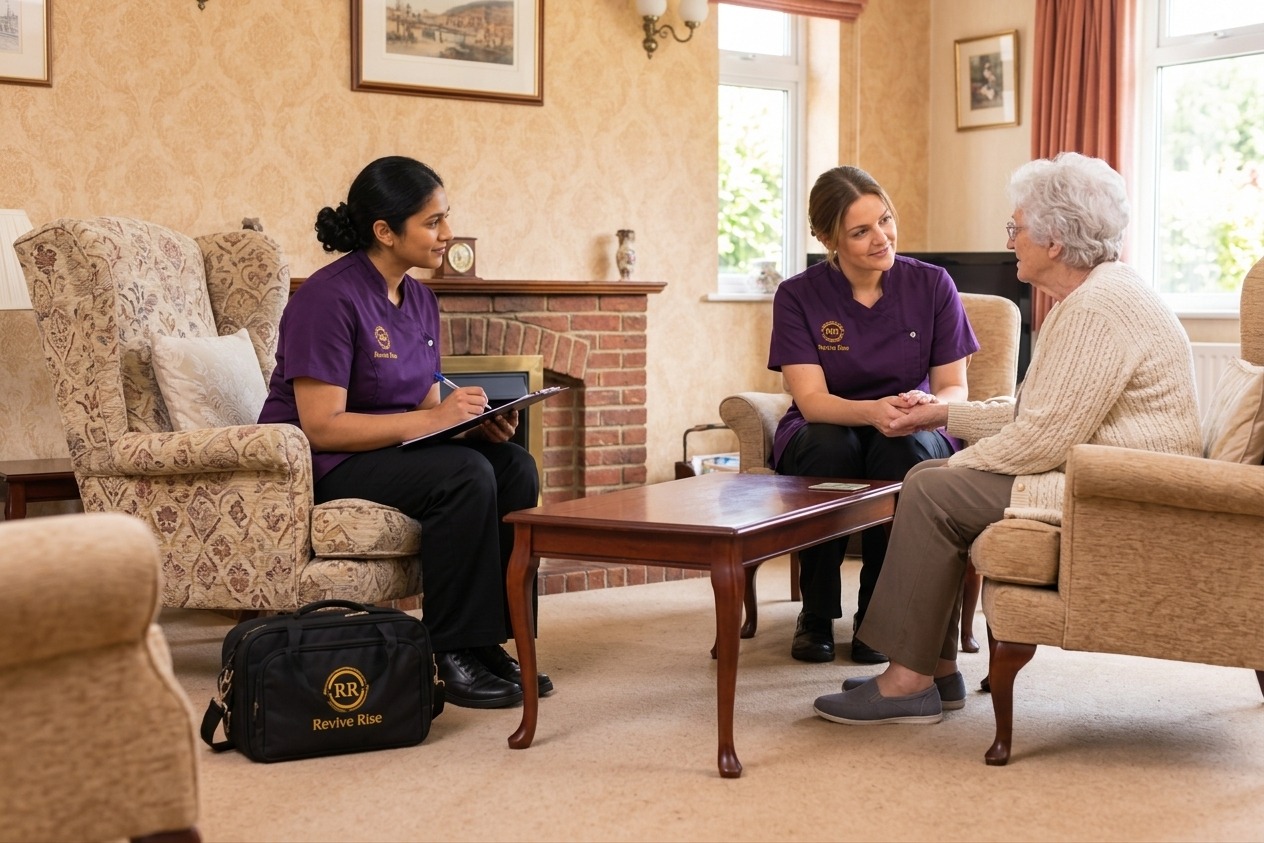
Planning home tracheostomy care in Birmingham may involve hospital discharge teams, respiratory specialists and home-care professionals. Clear handovers help everyone understand prescribed airway tasks, equipment requirements and responsibilities.
Nurse-led tracheostomy care in Birmingham starts with assessing staff competencies, respiratory monitoring and escalation procedures. We also discuss how the individual and family will receive updates as home-care arrangements are considered.
Tracheostomy care at home in Birmingham may involve airway observation, tube and stoma care, prescribed suctioning and respiratory equipment. Where complex respiratory care in Birmingham is required, the scope is agreed through an individual assessment, clinical instructions and appropriately trained staffing rather than a standard package.
Routine observation of breathing, oxygen levels and respiratory comfort, with changes reported and escalated according to the agreed care plan.
Support with appropriate tracheostomy tube and stoma care, cleaning, dressings and infection prevention in line with the person's clinical instructions.
Where clinically prescribed, competent staff may provide tracheostomy suctioning support in Birmingham and carry out secretion-management routines to help maintain a clear airway.
Assistance with prescribed ventilators, humidification, nebulisers and respiratory equipment according to assessed needs and specialist guidance.
Support for prescribed medicines and respiratory treatments within the individual's agreed plan and the team's scope of practice.
Individualised emergency procedures, equipment checks, competent staffing and timely escalation when breathing or airway concerns arise.
Help with safe positioning, transfers, mobility, personal care and routines that support comfort, dignity and independence.
Respectful communication, reassurance and consistent daily support for individuals adjusting to life with a tracheostomy.
Clear communication with relatives and the wider clinical team, including practical guidance where appropriate and authorised.
Birmingham families may enquire when a relative is preparing to leave hospital with a tracheostomy or needs an existing complex respiratory package reviewed. Suitability requires written clinical instructions, suitable staff, equipment and a safe home setup.
Have an overview of the current respiratory care, discharge contacts, intended Birmingham area and proposed support hours. A nursing assessment can then explore handover responsibilities and staff competency requirements.
Families considering tracheostomy nursing in Birmingham may be coordinating hospital clinicians, community professionals and home-care staff. Clear written handovers and communication routes help establish who is responsible for each element of support during a safe transition.
Complex respiratory care in Birmingham must account for the individual's prescribed monitoring and equipment alongside their communication, comfort and family routines. Clinical instructions, infection prevention and appropriate emergency escalation remain central to the plan.
When exploring tracheostomy hospital discharge support in Birmingham, families need clarity on clinical handover, equipment, appropriately trained staff and emergency procedures before care can begin. These stages outline that assessment-led process.
Clarify current clinical contacts, discharge information and who makes decisions about the person's airway care.
The nurse-led assessment checks prescribed suctioning, monitoring, equipment and the competencies each task needs.
A care arrangement is considered only after staffing, home readiness, emergency protocols and communication are agreed.
Reviews take account of clinical advice, changes in respiratory needs and feedback from the individual and their family.
If you are seeking support in Edgbaston, Erdington, Sutton Coldfield or another Birmingham neighbourhood, please explain the proposed address, clinical tasks and hours of care. Availability depends on individual assessment, staffing skills and equipment, not a blanket guarantee for every postcode.
Care costs depend on the assessed clinical tasks, trained staffing, equipment arrangements and hours required. Revive Rise can discuss a personalised quote after assessment; no fixed price is implied.
Whether short visits, longer shifts or overnight support can be considered in Birmingham depends on the assessed package and available appropriately trained staff. Timing must be agreed after care-readiness checks.
Some adults with complex, long-term health needs may qualify for NHS Continuing Healthcare at home. Eligibility is determined by an NHS assessment, not by diagnosis or the care provider. Local authority support may also depend on care and financial assessments.
Ask the discharge or community team about applicable funding routes; no funding approval is guaranteed.
Tell us whether the enquiry concerns a planned hospital discharge, a combined tracheostomy and ventilator requirement or an existing package needing review. We can explain what details help assess suitability and how communication with relevant clinicians may work.
Reviverise LTD (Revive Rise Complex Home Care) is listed by the Care Quality Commission under provider reference 1-20710962345. Care planning is nurse-led, and tasks must follow individual clinical instructions and staff competency requirements.
For patient information, see the NHS tracheostomy guidance and National Tracheostomy Safety Project. This page is general information, not a substitute for individual clinical advice.
To discuss a care concern, request a review or ask about safeguarding arrangements, contact Revive Rise. If someone is having serious difficulty breathing, call 999.