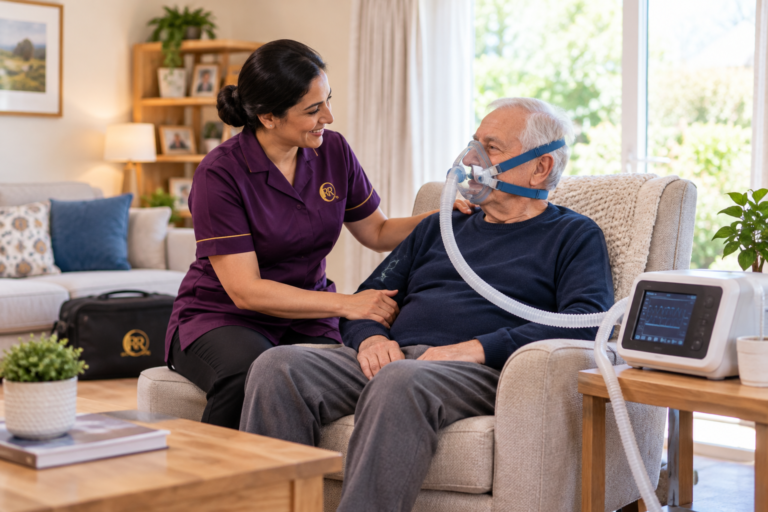

Caring for someone with a tracheostomy at home requires careful planning, appropriate clinical support and confidence that the people providing care understand the individual’s airway needs. For families, particularly those preparing for discharge from hospital, the transition can raise important questions about safety, equipment, suctioning, emergency procedures and day-to-day support.
With an individualised care plan and appropriately trained professionals, many people with tracheostomies can receive support within familiar home surroundings. For families considering tracheostomy care at home in Tamworth, understanding what specialist care involves is an important first step.
This guide explains how home tracheostomy care works, what support may be required and what families should consider when arranging a care package.
What Is Tracheostomy Care at Home?
A tracheostomy is a surgically created opening at the front of the neck that provides direct access to the trachea, or windpipe. A tracheostomy tube is inserted through this opening to help maintain the airway.
A person may require a tracheostomy for several reasons, including airway obstruction, neurological conditions, spinal cord injuries, prolonged mechanical ventilation or other complex medical conditions.
The NHS guidance on tracheostomy provides further information about why tracheostomies are performed and what living with a tracheostomy may involve.
Tracheostomy care at home means providing the clinical and personal support required to safely manage these needs outside a hospital environment. The level of support varies considerably. Some people can manage aspects of their own tracheostomy care, while others may require extensive assistance because of ventilation requirements, reduced mobility or additional complex health conditions.
What Does Tracheostomy Care at Home Include?
There is no single care routine suitable for everyone with a tracheostomy. Support should be based on an individual clinical assessment and an agreed care plan.
Depending on the person’s condition, care may involve:
- Monitoring breathing and airway status
- Tracheostomy tube and stoma care
- Suctioning when clinically indicated
- Managing and monitoring secretions
- Humidification support
- Supporting prescribed respiratory equipment
- Infection prevention measures
- Monitoring oxygen saturation when required
- Supporting communication
- Positioning and mobility assistance
- Nutrition and hydration support
- Emergency preparedness
- Recording and reporting changes in health
Some individuals may also require enteral feeding, medication support, ventilation or other clinical interventions. These needs should be considered together rather than managed as isolated tasks. Families can explore the wider range of specialist tracheostomy care provided by Revive Rise when considering how different aspects of care may need to be coordinated.
Why Is Specialist Training Important for Tracheostomy Care?
A tracheostomy provides direct access to a person’s airway, so anyone carrying out tracheostomy-related procedures must understand both routine care and potential complications.
Training may cover areas such as suctioning, infection prevention, secretion management, equipment use, observation of the tracheostomy site and emergency procedures. However, training alone is not enough. Care professionals should also be assessed as competent to carry out the specific procedures required by the individual.
They should know how to recognise potential warning signs, including increased difficulty breathing, difficulty clearing secretions, changes in secretions, unusual respiratory sounds, reduced oxygen saturation where monitored, possible tube blockage, tube displacement, signs of infection or unexpected changes in the person’s general condition.
Can Someone With a Tracheostomy Live Safely at Home?
Many people with tracheostomies can receive care at home when their clinical needs have been properly assessed and suitable support is available. Whether home care is appropriate depends on the individual rather than simply the presence of a tracheostomy.
An assessment may consider why the tracheostomy is required, ventilation needs, frequency of suctioning, secretion management, respiratory stability, mobility, communication, nutrition, medication, other health conditions, the home environment, equipment, emergency arrangements and the level of professional support required.
What Equipment May Be Needed for Tracheostomy Care at Home?
Equipment requirements should always be determined by the person’s clinical team and individual care plan. Depending on their needs, equipment may include suction equipment, humidification equipment, spare tracheostomy tubes, emergency supplies and prescribed respiratory monitoring devices.
People requiring mechanical ventilation will usually have additional specialist equipment. Required equipment should be available when needed, stored appropriately, maintained according to relevant guidance, incorporated into emergency planning and used by people who understand how to operate it safely.
What Are the Main Risks Associated With Tracheostomy Care?
Home tracheostomy care requires careful risk management because changes involving the airway can sometimes require an urgent response.
Tube Blockage
Secretions can potentially obstruct a tracheostomy tube. The person’s care plan may include appropriate humidification, secretion management and suctioning procedures to help maintain a clear airway.
Accidental Tube Displacement
A tracheostomy tube may become displaced or accidentally removed. Staff supporting the person should understand the individual’s agreed emergency procedure and escalation plan.
Infection
The tracheostomy site needs appropriate observation and hygiene. Changes such as unusual redness, swelling or discharge should be reported and assessed according to the person’s care plan.
Respiratory Deterioration
Changes in breathing effort, respiratory rate, oxygen saturation where monitored, secretion levels or overall responsiveness may indicate deterioration.
Why Is Clinical Oversight Important?
For individuals with complex clinical needs, effective care requires more than completing a list of daily tasks. Clinical oversight helps ensure that the care package remains appropriate as the person’s needs change.
This can include assessing clinical risks, developing individualised care plans, reviewing interventions, assessing staff competency, monitoring changes in health, updating risk assessments and coordinating with other healthcare professionals.
The Care Quality Commission (CQC) regulates health and social care services in England and provides information about the standards people should expect from registered care providers.
How Does Nurse-Led Tracheostomy Care Help Families?
Family members often provide significant emotional and practical support to someone living with a tracheostomy. However, relatives should not automatically be expected to take responsibility for complex clinical procedures without appropriate training and support.
Nurse-led care provides a clinical structure around the care package. Registered nurses can contribute to assessment, risk management, care planning, staff competency, clinical reviews and communication with other professionals where appropriate.
You can learn more about the provider and its approach to care on the complex care services page.
Arranging Tracheostomy Care After Hospital Discharge
Moving from hospital to home is a significant transition, particularly for someone who has recently received a tracheostomy or whose clinical needs have changed. Discharge planning should ideally begin before the individual leaves hospital.
The process may involve hospital clinicians, discharge coordinators, respiratory specialists, community healthcare professionals, the home-care provider and family members. Before the person returns home, there should be clarity around staffing, care schedules, clinical procedures, medication, equipment, staff competency, emergency procedures and escalation arrangements.
How Can Specialist Home Care Support Independence?
Having complex clinical needs does not mean that every aspect of a person’s life should revolve around medical care. A person-centred care plan should consider the individual’s routines, preferences, communication, relationships and personal goals alongside their clinical requirements.
Depending on their circumstances, this could mean supporting them to participate in rehabilitation, spend time with family, access the community, continue hobbies or gradually become more involved in managing aspects of their own care.
For families looking for local support, home care in Tamworth provides nurse-led home care from its Tamworth base, with care planned around each person’s individual requirements.
How to Choose a Tracheostomy Care Provider in Tamworth
Families should consider the provider’s clinical capability rather than choosing solely on the basis of general home-care experience. Ask about experience supporting people with tracheostomies, clinical oversight, staff training and competency assessment, care-plan reviews, out-of-hours clinical support, emergency procedures, multidisciplinary coordination and how the package can adapt as needs change.
Nurse-Led Tracheostomy Care in Tamworth With Revive Rise
Revive Rise provides nurse-led home care for individuals with complex healthcare needs in Tamworth and across the West Midlands. As a CQC-regulated provider, Revive Rise uses clinical oversight from NMC-registered nurses to help plan, supervise and review care packages. Support is tailored around the individual’s assessed needs rather than applying the same care model to every person.
For someone living with a tracheostomy, this may involve coordinating airway management with personal care, mobility support, nutrition, medication and other complex-care requirements. Care requirements can evolve over time, making regular review important.
Discuss Tracheostomy Care at Home in Tamworth
Arranging tracheostomy care at home in Tamworth should begin with a detailed assessment of the individual’s clinical needs, current abilities, home environment and required level of support. Whether care is being arranged following hospital discharge or for someone already living at home with a long-term tracheostomy, Revive Rise can discuss the available nurse-led support and help determine an appropriate care approach.
Frequently Asked Questions
Can a person with a tracheostomy be cared for at home?
Yes. Many people with tracheostomies can receive care at home when their clinical needs have been appropriately assessed and the necessary trained staff, equipment and emergency procedures are in place.
Does someone with a tracheostomy need a nurse 24 hours a day?
Not everyone requires continuous registered nursing. The appropriate staffing arrangement depends on the individual’s condition, clinical risks and required interventions.
Can tracheostomy care be provided 24 hours a day?
Yes, where an assessment identifies a need for continuous support, care can be structured around the individual’s requirements throughout the day and night.
Can home tracheostomy care include ventilation support?
Some people with a tracheostomy also require mechanical ventilation. Supporting these individuals at home requires appropriate clinical planning, trained staff, suitable equipment, monitoring and emergency procedures.
How is tracheostomy care arranged after hospital discharge?
Planning usually involves assessing the person’s clinical and practical needs, arranging suitable staffing and equipment, establishing emergency procedures and coordinating with relevant hospital and community professionals before the person returns home.